Wednesday, July 29, 2009

How to get an Organizational TRansformation Right

Now that companies have finished cutting, closing, "right sizing", etc., it’s time to figure out what to do with what’s left. Executives are now trying to figure out how to get their new, leaner organizations focused on driving performance again. In their haste to reduce costs quickly companies now find themselves with “lumpy” or “overtaxed” resources and/or essential areas completely gone.

Where to start? Here’s what I’ve learned on where to start, and how to be successful. I call it the “T’s” and “R’s” of organizational transformation.

TARGETS – the starting point and the first “T”. Given the new economic reality, how targets are determined, agreed upon, forecasted and measured all must be rethought. That new thinking then must cascade its way down through the organization. Once defined and communicated, you then move on to the addressing the second “T.”

TOOLS - what tools are needed by the organization in order to reach the targets? In this category, I include key enablers such as process, infrastructure, systems and measurement, etc. If this is not addressed fully...it will impact how you evaluate the next “T.”

TALENT – once you have an understanding of the results you’re trying to achieve and a good idea of what tools are needed THEN you address Talent. This includes defining skill sets, competency, organizational structure, roles & responsibilities. This particular “T” also creates a subset of “R’s”.

The R’s include:

  • REALLOCATE - correctly allocating resources along the work flow should address the “lumpy” effect. Depending on the approach your organization took during the downturn will determine the amount of work you’ll need to do here. For example, in companies that made headcount reductions across the board…this may not be an issue. But for others that made cuts based on a performance and/or a ranking system, it could be a big deal…e.g. one group may have remained relatively untouched based on their performance while another part of the organization was completely decimated.
  • REALIGN – resources may have to be realigned based on gaps left by RIF’s. Also, changes in corporate and/or customer needs and/or priorities may also bring about a need for “realignment.” Make sure you address compensation and performance objectives (e.g. MBO’s) during this step.
  • REFRESH – could also call this step “reinvigorate.” After everything your team has been through during the past 12 to 18 months, it’s time to motivate them…this is not a “one and done” event. Build a 12 month plan and be consistent.
  • RECRUIT - after all is said and done you may need new talent (for example, analytics, social media, etc.) either “coach 'em up” through training (the last “T”) and/or bring in new skills sets.

TRAINING – now that the resources are aligned, it's time to ensure that everyone knows how to use the tools, execute on their responsibilities, etc. Yes, it’s time to invest in your staff...again!

Thursday, July 16, 2009

5 Key Questions for Creating a Compelling Value Proposition & an Integrated Communication Plan

I’m about to share with you the secret formula for; 1) creating a rock solid, compelling value proposition (for products, services, solutions, etc.) and, 2) aligning (enterprise wide) your corporate communications. It will seem like a very simple approach, and it is, but once you try to get consistent answers from the organization to the following questions (in order) you will understand why this is so challenging...and why so many companies fail.

Keep this in mind, effective communication to customers must happen through a consistent delivery of the right message, to the right customer, at the right time, in the right channels to facilitate effective, efficient dialogue.

This is how you do it. You have to be able to collectively (with the right internal groups) answer the following five questions in order:
  1. Who? – what audience/segment are you targeting, and why
  2. What? – what do you want/have to say to that segment that is relevant
  3. Why? – why would they listen
  4. When? – when do you contact them, and how often
  5. Where? – where do they want to receive the message
Sounds simple right? If only. Here are a list of challenges you will face when go through the process:

  • Who - right off the bat, you will find folks arguing about your target audience, the segmentation approach, the segments, etc.
  • What – oh, you’ll have plenty of things you what to tell whatever audience you settle on but you will struggle with relevancy
  • Why - now comes the killer question…why would they listen? Seen this question bring grown men (and women) to their knees. The reasons are many; Marketers don’t understand the products, products aren’t differentiated, etc. Getting this question right is the key to the whole process.
  • When – the challenge is deciding on at what point in a sales process, a marketing campaign, events, etc., and the frequency of contact. Touch them too often and/or at the wrong point you’ll get opt-outs, too infrequently, you’ll get no mindshare.
  • Where – notice that I said, "they", and not "you" on where the communication happens. Yes, it's about your customer and where they go for information not where you want to put it. Find out where your audience goes to get information and/or determine their perference for receiving it. The othe challenge is ensuring that the message fits the channel. Certain messages/value proposition, etc. fit a certain channel better than others. It’s worth the time to figure this out.
This approach creates an execellent output but it will take time, discipline and many iterations to get right...good luck.

Wednesday, June 24, 2009

7 Steps to Creating a Social Media Strategy

Lots of clients are now interested (finally) in getting their Social Media house in order. Fortunately, there is a ton of information on Social Media available…unfortunately; I haven’t seen anything that tells a Marketer what to do about it.

After spending a year and a half on this topic and working with clients, here's a quick “To Do” list based on the best and worst practices observed. The first 3 deal with the current state, the remaining 4 are future looking. At this point you should have the first three steps in place.

Current State – get this done TODAY
  1. Educate – up, down and all around. This space is moving so fast that getting senior executives up to speed on the tools is critical for getting the right focus on the right topic the right way (more on that to come). Senior executives like simple visuals that tell a quick and easy story. I'd also recommend putting together a cross functional "task force" to focus on Social Media. Blend a mix of heavy users and novices it can be very effective for helping educate the organization. For example, in the "Dot.com" days, Merck assembled a cross functional team to work on Web 1.0 for about a year. Team members then went back into their respective regions/divisions/LOBs to spread the gospel and implement learnings...like it...like it alot.
  2. DO NO HARM – while it may take time for a company to get a clear understanding of the upside of Social Media, it may only be a matter of seconds to get a feel for the downside. One of the things that is fascinating, for better or worse, about social media is its speed and reach. A company HAS to clearly map out Risk and how to handle certain scenarios…which leads me to the next point.
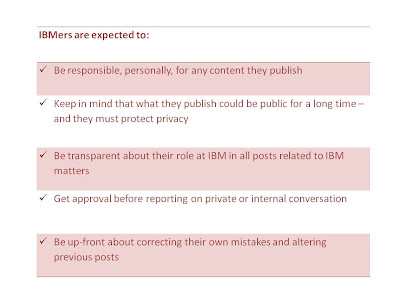
  3. Create standards/protocol/guidelines – after building a solid knowledge foundation of the tools and their functionality and mapping the risk, the organization is now ready to issue a set of guidelines for employees when it comes to using social media (see the IBM guidelines in my last post).
Future Vision – get this done by the end of the year
  1. Decide on what you want Social Media to do – this IMO is the most important step that is being missed by most companies currently and the reason…see Step 1. Companies are experimenting (which I applaud) but based on my experience it has not been aligned against a clear objective/s. With budgets harder to get and/or retain you have to have clear vision as to what you are trying to impact/accomplish/achieve (see the video on the “Six Sweetspots”).
  2. Map the Value – Another thing to remember about Social Media is that there really isn’t anything truly new. The tools just do something that already exists but faster, better or cheaper. In an article in Time magazine featuring Twitter, you’ll learn that Twitter’s 140 character limit was based on the first question asked on most phone conversations (What are you doing?). So think about those things that most impact your business – customer satisfaction and loyalty, new product innovation, etc. and find a role for these tools that either augments current efforts and/or may fill a gap (because of cost, reach, etc.).
  3. Align against key Metrics – many companies are struggling with this one. They say that can’t fund experimentation because they can’t, or don’t know, how to measure the value or ROI. That’s right…because many of the tools, tactics, etc. aren’t measurable on their own. Again back to my point above…they do something better, faster or cheaper, so align them against the metrics already in place. For example, let’s say you’d like to do a customer survey and the goal is to get 200 completed surveys. Use Twitter to announce the survey and watch how fast you get to 200…it will knock off days, believe me. The goal is # of completed surveys, Twitter accelerated the process (and probably saved you some money on incentives)…that’s the value.
  4. BUY, DO NOT BUILD – unfortunately many companies who have funds to invest have wasted them on building their own branded sites/tools, internal capabilities, etc. Here’s the thing, Web 2.0 as I’ve mentioned before is about “Consumers Selling to Consumers.” Get it…not “Companies Selling to Consumers”...we have plenty of that happening already.

    When companies overly commercialize and/or control Social Media tools they fail (e.g. no audience, interaction, etc.). That’s what makes this space so tricky…you (companies) aren’t in control…but you love trying to have it…can’t help yourself and that’s when things fail.

For example, it's better to video a customer testimonial on buying insurance and hang it in a site like eHow than to invest in a production studio and shooting a “How to buy life insurance” video for their channel. Plus, this space is moving so fast that you will probably invest in something that will have a shelf life of less than 12 months…remember when MySpace used to be hot. BTW - it's dying because Ruppert has moved it into the lower right hand corner of the quadrant above.

The upside of the downturn is that you have to be frugal and that may turn out to be a really good thing. Get smart now, then act.

Thursday, June 11, 2009

The New Online Paradigm


In 1962, Thomas Kuhn wrote The Structure of Scientific Revolution, and fathered, defined and popularized the concept of "paradigm shift." Kuhn argues that scientific advancement is not evolutionary, but rather is a "series of peaceful interludes punctuated by intellectually violent revolutions", and in those revolutions "one conceptual world view is replaced by another".

So what if you spent half your time at work on Linked-In, Facebook or Twitter? Yes, the recession has slowed business significantly.  I’m not talking about surfing the net because you have nothing better to do, I’m talking doing this AS PART OF YOUR JOB.

In a recent survey by Michael Stelzner, on social media marketing almost 10% of the survey respondents spent 20+ hours a week on social media marketing. Ask senior executives in marketing in my age demographic (age 40-44) and they’ll tell you; “I don’t get it…” In the past, spending time online at work to do personal business was viewed as a major productivity waster.

In a 2006, INC reported the productivity loss to be as high as $544 billion dollars (just think about that, if we all stopped surfing the net at work we could fund the Federal bailout of the Banking, Insurance and Auto industries). As a result, companies took dramatic measures to block or monitor access to sites, tools like IM and other “distracting” technologies.

Now after years of being told that being online at work was a bad thing, this new research and the appeal of Social Media sites, makes the case that it’s not only safe, but in certain cases, necessary to be online. According to the Salary.com & AOL survey, the average 2 hours a day American workers wasted in 2006 surfing the net is now the average time needed to do social media marketing...my, my how times have changed.

And what might be most surprising is that may be “OK” with the boss - the most active users of sites like; Facebook, Twitter and LinkedIn are small business owners according to Stelzner's report.

Other interest findings from the research:

  • A New Day is Dawning - although 88% of marketers reported using social media for marketing, 72% have just started (less than 3 months).
  • Once You Start…You Can’t Stop – the research points out a direct correlation between how long marketers have been using social media and their weekly commitment. For folks just starting, the mean is 2 hours a week, compare that with folks who have been at it for years…an average of 20+ hours.
  • One Thing Leads to Another - the more time you log, the more tools/sites you’ll use. Similar to the old thinking that cigarettes and alcohol lead to the “harder” stuff, the same is true with Social Media usage. The “newbies” like to start with LinkedIn, hard core users are most interested in social bookmarking sites, FriendFeed and StumbleUpon.
  • Not the “Young'ins” – contrary to popular belief, it’s the 30 to 39 year old segment that logs in the most time, with 44.8% reporting spending 10+ hours a week.
  • Small Business “Sweetspot” – small businesses love social media marketing because it has generated exposure for their business, leads and partnerships, and to close business.
So if you’re going to be logging some social media hours on the company dime you might want to follow a protocol to keep the lawyers happy. In an article entitled "Managing the Tweets" in the June 1, 2009 edition of Business Week the author lays out IBM’s social media guidelines.

As you may have noticed, I’ve been sitting on this report since March. At first I had a hard time believing some of the results…still do, but then it occurred to me that maybe I needed to shift my paradigm. Not sure that I’m ready to “replace my conceptual world view with another” but given current trends I guess we in the “post 30-39 generation” do need to be open to it.

Kuhn maintained that, scientist are, in essence, puzzle-solvers who aim to discover what they already know in advance - "The man who is striving to solve a problem defined by existing knowledge and technique is not just looking around. He knows what he wants to achieve, and he designs his instruments and directs his thoughts accordingly."

The upside is if I do “replace my world view” it should give me 20+ hours per week to spend on social media...it may even help me turn around a blog post in less than 3 months.