Thursday, June 11, 2009

The New Online Paradigm


In 1962, Thomas Kuhn wrote The Structure of Scientific Revolution, and fathered, defined and popularized the concept of "paradigm shift." Kuhn argues that scientific advancement is not evolutionary, but rather is a "series of peaceful interludes punctuated by intellectually violent revolutions", and in those revolutions "one conceptual world view is replaced by another".

So what if you spent half your time at work on Linked-In, Facebook or Twitter? Yes, the recession has slowed business significantly.  I’m not talking about surfing the net because you have nothing better to do, I’m talking doing this AS PART OF YOUR JOB.

In a recent survey by Michael Stelzner, on social media marketing almost 10% of the survey respondents spent 20+ hours a week on social media marketing. Ask senior executives in marketing in my age demographic (age 40-44) and they’ll tell you; “I don’t get it…” In the past, spending time online at work to do personal business was viewed as a major productivity waster.

In a 2006, INC reported the productivity loss to be as high as $544 billion dollars (just think about that, if we all stopped surfing the net at work we could fund the Federal bailout of the Banking, Insurance and Auto industries). As a result, companies took dramatic measures to block or monitor access to sites, tools like IM and other “distracting” technologies.

Now after years of being told that being online at work was a bad thing, this new research and the appeal of Social Media sites, makes the case that it’s not only safe, but in certain cases, necessary to be online. According to the Salary.com & AOL survey, the average 2 hours a day American workers wasted in 2006 surfing the net is now the average time needed to do social media marketing...my, my how times have changed.

And what might be most surprising is that may be “OK” with the boss - the most active users of sites like; Facebook, Twitter and LinkedIn are small business owners according to Stelzner's report.

Other interest findings from the research:

  • A New Day is Dawning - although 88% of marketers reported using social media for marketing, 72% have just started (less than 3 months).
  • Once You Start…You Can’t Stop – the research points out a direct correlation between how long marketers have been using social media and their weekly commitment. For folks just starting, the mean is 2 hours a week, compare that with folks who have been at it for years…an average of 20+ hours.
  • One Thing Leads to Another - the more time you log, the more tools/sites you’ll use. Similar to the old thinking that cigarettes and alcohol lead to the “harder” stuff, the same is true with Social Media usage. The “newbies” like to start with LinkedIn, hard core users are most interested in social bookmarking sites, FriendFeed and StumbleUpon.
  • Not the “Young'ins” – contrary to popular belief, it’s the 30 to 39 year old segment that logs in the most time, with 44.8% reporting spending 10+ hours a week.
  • Small Business “Sweetspot” – small businesses love social media marketing because it has generated exposure for their business, leads and partnerships, and to close business.
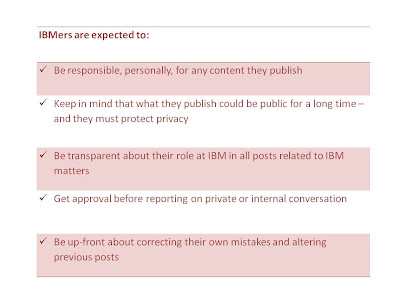
So if you’re going to be logging some social media hours on the company dime you might want to follow a protocol to keep the lawyers happy. In an article entitled "Managing the Tweets" in the June 1, 2009 edition of Business Week the author lays out IBM’s social media guidelines.

As you may have noticed, I’ve been sitting on this report since March. At first I had a hard time believing some of the results…still do, but then it occurred to me that maybe I needed to shift my paradigm. Not sure that I’m ready to “replace my conceptual world view with another” but given current trends I guess we in the “post 30-39 generation” do need to be open to it.

Kuhn maintained that, scientist are, in essence, puzzle-solvers who aim to discover what they already know in advance - "The man who is striving to solve a problem defined by existing knowledge and technique is not just looking around. He knows what he wants to achieve, and he designs his instruments and directs his thoughts accordingly."

The upside is if I do “replace my world view” it should give me 20+ hours per week to spend on social media...it may even help me turn around a blog post in less than 3 months.

Thursday, May 21, 2009

Digital Enablement in the Insurance Industry - part I


On May 7th, we hosted a live webinar entitled the Digital Enablement of the Agent Channel. The webcast shared the results of our recent research on how companies in the insurance industry are utilizing Web 2.0 tools to support agents.

In this two part video summary, I shared six key areas where digital may have a business impact. Our research concluded that the industry is experimenting with new tools, in particular Social Media, but those efforts seems to lack an alignment to driving business impact. In this brief informative video, viewers will learn where to “place their Digital bets.”

Thursday, May 14, 2009

The Social Experiment


The answer to the question I asked in my last blog post is 3 hours and 48 minutes.
Tuesday’s blog post was an interesting experience/experiment in watching Social Media at work.
After posting the blog at 10:12 am and ending the post with this challenge; “Now, let’s see if they are as good as I think they are…how long before they pick this up and respond?” Richard Hammer (the author of the blogpost on Allstate & Twitter) posted a comment at 2:04 pm.
The question is how did they find out so fast? I asked our Director of Marketing the same question; “If someone wrote a story on MarketBridge how long would it take for us to pick it up?” He mentioned about a day, which sounded reasonable, but now it makes you think...is that too long?
After working with clients for years on improving their tracking, measuring and overall campaign and program effectiveness, Social Media suggests a whole new set of questions about how to track marketing efforts. We used to live in a world where we tracked programs over months/years, and campaigns over weeks/months. Now we’re dealing with hours or less …from “analog hours to digital minutes” as my colleague, Andy Hasselwander likes to say.
I still remember the impact of telling a client a few years ago that the effectiveness of an email campaign lasted less than 72 hours. Now we could be dealing with 72 minutes. It’s fascinating to watch and holds great potential, if understood. And if the social media platform providers can figure out how to monetize their models…e.g. right now Facebook is growing faster than their revenue model can support and how will Twitter make money?
This potential evolution/revolution poses some very interesting questions for marketers, such as:
  • How long will “freeness” last?
  • What platforms will be left and who will own them? Really, how many Microblogs do we need?
  • How do I measure the impact of a “flash?"
  • How do I control the “reach and direction” of my communication?
  • Do I have to worry about privacy issues if everything is in the public domain?

So how did Modea find out that I blogged about them so fast? Google Alerts (free) as David mentions in his comment, most likely it was set to alert once a day, probably the reason why Michael thought it took them 8 hours to respond. How did I get comments from Modea bloggers, who I mentioned in the post, but not by name? Because the blog post was posted on Modea’s Facebook (free) page.


How did they know about the story so fast? Twitter (free) most likely from their Facebook posting. At least 6 people “tweeted” about story and linked to the post. How did I know? I searched Twitter (in the public domain) and Google Analytics (free).


How do I know they came from Facebook? The same way I know that there were 34 visits from 32 people from Blacksburg, VA to the post within the first 8 hours, Google Analytics (free).

Hope this helps answer the question about tracking Social Media. The bigger question is who will receive the value/benefit from “freeness” for now? My bet is Social Media/Digital agencies like Modea, who have grown incredibly fast over the last three years, because they understand how to use the “free platforms.”

How do I know…it’s in the public domain...just like all the information above. How long will it last...now that's a good question.

Monday, May 4, 2009

Social Media Agency uses Social Media to Promote Itself


How do you find Digital talent in an area of the country that is anything but a marketing hot spot? Don’t get me wrong Blacksburg, VA is a great college town, especially, if you’re a Hokies fan, but Digital Agency Mecca? Ah, no.

Where does a new fast growing Digital agency recruit that kind of talent? Well, being based in Virginia you go to the closest talent markets…Richmond, VA for creative folks (home of the Martin AgencyGieco Caveman and Gecko, fame) and to Northern Virginia (NoVA) for Web Developers, Account Managers, etc.

But how do you get them interested in a small, relatively new agency in the middle of nowhere that specializes in social media? Simple, apply what you know… social media. Modea, a growing digital agency in southwest Virginia took a dose of its own medicine and pulled off a subtle but effective effort.

Recently and by accident, we picked up a couple of blog posts that made it into the mainstream media written by Modea employees. The first blog post, written by a recent grad, appeared in Ad Age on 4/13. The article, cleverly written, describes the author’s interview process/courting process with Modea and gave tips for other recent graduates looking for a job in this challenge environment…it also conveniently mentions the firm, Twitter, Facebook, etc.

It describes how she started her search on VCU’s BrandCenter Facebook page (recruiting Richmond talent). She points out that she had reservations about moving to Blacksburg. And, of course she subtlety gets in the plug for the agency…

"Modea is neither an agency nor a think tank. It is an idea-churning society."


Original? Not really, we found the exact quote in a photo of the Modea offices on their Facebook page. It was printed on a piece of paper and taped to conference room wall. Looks like she's "on brand."

The second ad/blog post was written by a Web Application Developer at Modea and appears on Handshake 2.0. This post is aimed at the NoVA crowd. Again, cleverly written as a blog post, it describes the experience of another recent hire that left Northern Virginia for the hills of Southwest Virginia.

He starts his story with the fact that he recently transplanted his family from NoVA to Blacksburg…”to take advantage of an amazing job opportunity.” Ah, there it is…the plug.

The author goes on to talk about his pipes bursting while he had the house on the market during a “bitter cold stretch.” He posted a Twitter status update that he was in "good hands with Allstate" and how quickly they responded to his post.

Through telling of his ordeal he also convenient slips in his initial skepticism about Twitter but now how it’s the greatest thing since Web 1.0.

"Here is a brand and a company that, in my opinion, gets it. Here is a visible, public social medium where people are sharing publicly their views and thoughts on anything and everything in their lives. Communities are sharing their experiences and current state of consciousness. Consumers are expressing opinions, both positive and negative, about the world around them and how they interact with it. It would be a missed opportunity for any brand to ignore this medium. Listening and being aware of what is being said about their brand, allows them to, in some cases, actually do something positive and nurturing about it”.

Now I'm not exactly sure what ol’ Mr. Web Application Developers job is at Modea but I’d be willing to bet it has something to do with helping clients with their Twitter strategy.

Anyway, with all this being said I have to take my digital hat off to these guys. Two things could explain this bloggin coincidence and both of them are good.

The first is that this is a well thought out Social Media campaign (which yes, happens to be one of the services that Modea offers). The second is it’s a case of passionate employees who are raging advocates applying their craft to spread the good word about a company they love (or perhaps there’s a big employee referral bonus). Either way…well done, Modea! You’re best in class either way.

Author’s note – I have no connection to Modea. I’m not being paid to endorse their services, I have no stake in the company, I’m not even a client…just a fan…or am I? Now, let’s see if they are as good as I think they are…how long before they pick this up and respond?